


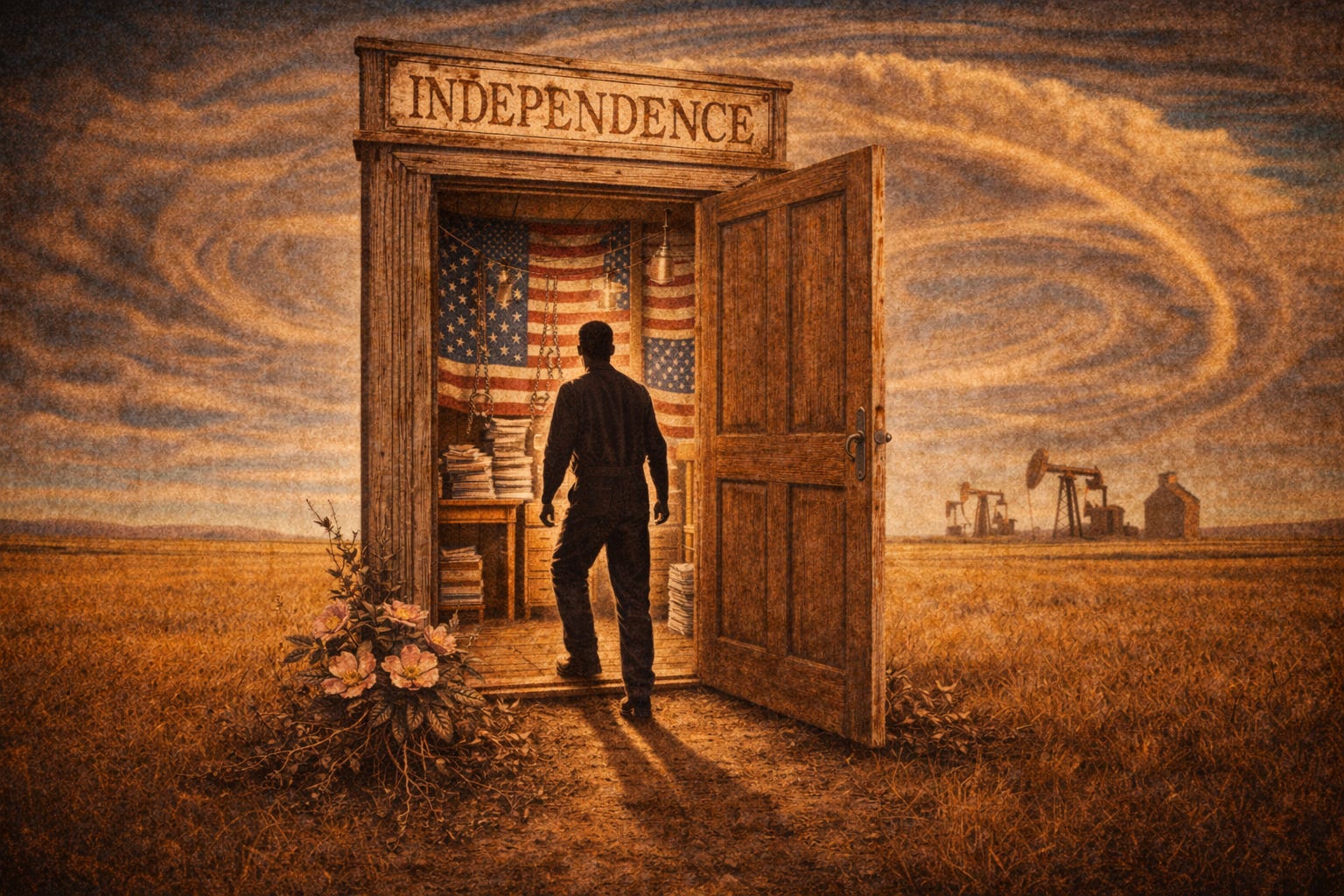
If Part 1 was about the story separatism tells, Part 2 is about the part it avoids.
Because once you accept a basic premise, the whole posture changes.
If Alberta did not enter Confederation as a sovereign nation, then separatism is not “restoration.”
It is rupture.
So the only honest question is not “Why would Alberta want to separate?”
It is: who benefits if it does.

Secession is not gathering signatures or venting frustration
It is the slow, unforgiving work of borders, law, and power.
In Canadian law, secession is not a unilateral provincial act. The Supreme Court’s secession reference makes the core point: a clear referendum result creates an obligation to negotiate, but it does not create a magic trapdoor out of the Constitution.1
Those negotiations would necessarily engage the Constitution, the federal government, other provinces, and Indigenous rights and treaty relationships.23
This is where the separation fantasy runs into the real world and starts sweating through its shirt.
Secession is not a reset button. It is an immediate crisis of dependency.
An independent Alberta would be forced to resolve, quickly and without leverage, a set of foundational questions that Canada currently absorbs on its behalf.
Currency
Trade access
Border control
Defense
Treaty continuity
Regulatory alignment
None of these questions point inward. They point south.
This is not ideology. It is geography, infrastructure, and market gravity.
The U.S. is not the only actor, but it is the obvious gravitational force
Alberta’s economy is deeply tied to the United States. Canada’s crude oil exports go overwhelmingly to the U.S., and Alberta is the single biggest source of that flow. In 2023, the U.S. received about 97 percent of Canada’s crude oil exports, and Alberta contributed the majority of the volume exported to the U.S.4
The energy system itself is integrated. Pipelines, refineries, pricing benchmarks, and demand patterns all pull south.5
The U.S. Energy Information Administration has also documented how significant Canadian crude is to U.S. refining, including the scale of imports from Canada and their role in refinery throughput.6
So, yes. If Alberta leaves Canada, the U.S. becomes the unavoidable negotiating partner on day one.
Not because Americans are villains, but because geography is stubborn.
The American advantage is leverage, not conquest
When people hear “who benefits,” they picture flags and invasions. That is not how modern negotiation advantage usually works.
The strategic benefit is leverage.
A smaller, newly independent, landlocked petrostate with an urgent need for market access is easier to pressure than a G7 federation with diversified ports, alliances, and a national negotiating apparatus.
Read that again.
The pressure does not have to be dramatic. It can be boring. Boring is the point.
Regulatory alignment here
Procurement preferences there
Pipeline terms, refinery terms, security terms
Quiet trade concessions packaged as “stability”
None of this requires anyone in Washington to hold a cartoon meeting called “Operation Separate Alberta.”
It just requires the incentives to be obvious.
Here is the part separatism does not like
Separation does not free Alberta from dependence.
It concentrates it.
If Alberta leaves Canada, it will still need:
access to U.S. customers
access to U.S. capital
access to U.S. refining and pipeline networks
access to a rules-based trade regime that is negotiated, not assumed
Independence would not mean autonomy.
It would mean renegotiating your dependence from a weaker position.
That is the difference between a province inside Confederation and a small country outside it.
Energy Sovereignty That Turns Into Dependence
Inside Confederation, Alberta enjoys leverage in global energy markets.
Its natural resources are constitutionally protected under section 92A of the Constitution Act, 18677. Its exports are negotiated as part of a G7 economy. Its disputes occur within a rules-based system that disperses risk.
Outside Confederation, Alberta becomes a landlocked exporter with one dominant customer.
Why Trump really wants Canada (Hint: It's Not the Oil)

AI is changing everything, faster than anything we have built before. We are watching models blow past human performance in task after task, and the compounding is brutal: once you optimize a model for a job, you can scale it at near-zero marginal cost. That is the corporate dream and the state’s dream: swap the most expensive input, human labor, for in…
In 2023, approximately 97 percent of Canada’s crude oil exports went to the United States, with Alberta accounting for the vast majority of that volume.8
Separation would not diversify that relationship. It would entrench it.
Price setting power would weaken. Exposure to U.S. trade disputes would increase. Regulatory asymmetry would widen.
Energy sovereignty inside Canada becomes energy dependency outside it.
Currency Gravity Is Not Optional
An independent Alberta would face three realistic options.
Create a new currency.
Use the Canadian dollar without control.
Adopt the U.S. dollar.
Each option reduces autonomy.
Dollarization would hand monetary policy to the U.S. Federal Reserve without representation or recourse. Alberta would absorb interest rate decisions, inflation targeting, and financial shocks designed for a different economy.9
Canada currently buffers Alberta from those shocks. Independence removes that buffer.
Currency is not symbolism. It is power.
Defense, Security, and the Cost of Standing Alone
Canada absorbs security responsibilities Albertans rarely think about.
Continental defense through NORAD
Border enforcement
Cybersecurity coordination
Arctic sovereignty
An independent Alberta would not replicate these systems. It would rely on U.S. security guarantees, formally or informally.
That reliance would shape foreign policy, trade policy, and domestic regulation whether Albertans wanted it to or not.10
Small states do not get neutrality by default. They get alignment.
Treaties Do Not Become Easier Outside Canada
Separation would not simplify treaty relationships. It would complicate them dramatically.
As we learned in Part 1, Indigenous treaties predate Alberta and are constitutionally recognized within Canada under section 35 of the Constitution Act, 1982.11 Any attempt at secession would immediately elevate First Nations to constitutional and potentially international actors.
How to Break Up With Canada: A Premier’s Guide to Going It Alone

Imagine a province voting to break away from Canada. What would happen next? This scenario, once largely associated with Quebec, has resurfaced in talk about Alberta’s future.
Canada is built to manage that reality. Alberta is not.
The United States has no incentive to protect Indigenous treaty rights in this context. Canada does, because it is bound to.
That distinction matters.
Who Actually Benefits
Once incentives are traced rather than slogans repeated, the beneficiaries are clear.
U.S. energy buyers gain a weaker negotiating partner.
Multinational firms gain leverage over a smaller regulatory state.
American strategic planners gain influence over a resource-rich region without negotiating with Ottawa.
Albertans gain uncertainty.
The story of independence sounds like self-determination.
The outcome looks like dependency.
Why the Idea Persists Anyway
If separation weakens Alberta while strengthening external leverage, the question becomes why the idea keeps circulating.
The answer is not policy. It is identity.
Separatism converts frustration into belonging. It supplies an antagonist. It offers emotional coherence during economic transition.
That is powerful.
Disinformation does not create grievances. It weaponizes them
Disinformation is not just about getting a fact wrong. It changes how people see each other, how they relate to their country, and how they understand democracy itself.
In Canada, major public reporting and assessments have warned that hostile actors use information campaigns and cyber-enabled influence to shape opinion, intimidate communities, and weaken trust.
You do not have to invent a grievance to exploit it.
You just have to feed it until it becomes identity.
And separatism is, above all, an identity project.
A positive note, because Alberta deserves one
Alberta is not a captive colony. Alberta is a strong province inside a wealthy federation, with real constitutional powers, real economic weight, and a population that has repeatedly demonstrated resilience through boom and bust.
The real Alberta story is not victimhood.
It is competence under pressure.
And that is exactly why this matters.
The stronger Alberta is within Confederation, the less attractive the breakup fantasy becomes to anyone looking for leverage.
Next up in Part 3: how foreign interference and disinformation campaigns exploit grievance politics, how modern conflict works now, and why the “Crimea pattern” matters even when no one is firing a shot.
Fault Lines, Part 3 of 3: The Crimea Pattern

If Part 1 was about the story Alberta separatism tells, and Part 2 was about who benefits if the breakup fantasy ever became real, Part 3 is about the mechanism.
Sources
Supreme Court of Canada. (1998). Reference re Secession of Quebec, 1998 CanLII 793 (SCC).
https://www.canlii.org/en/ca/scc/doc/1998/1998canlii793/1998canlii793.html
Parliament of Canada. (2000). Clarity Act (S.C. 2000, c. 26). Justice Laws Website.
https://laws-lois.justice.gc.ca/eng/acts/C-31.8/
Government of Canada. (1982). Constitution Act, 1982 (Schedule B to the Canada Act 1982 (U.K.), 1982, c. 11), s. 35. Justice Laws Website.
https://lois-laws.justice.gc.ca/eng/ConstRpt/Const_index.html
Canada Energy Regulator. (2024). Market Snapshot: Almost all Canadian crude oil exports went to the United States in 2023. Government of Canada.
https://www.cer-rec.gc.ca/en/data-analysis/energy-markets/market-snapshots/2024/market-snapshot-almost-all-canadian-crude-oil-exports-went-to-the-united-states-in-2023.html
Canada Energy Regulator. (2025, February 12). Market Snapshot: Overview of Canada-U.S. Energy Trade. Government of Canada.
https://www.cer-rec.gc.ca/en/data-analysis/energy-markets/market-snapshots/2025/market-snapshot-overview-of-canada-us-energy-trade.html
U.S. Energy Information Administration. (2024). Canada’s crude oil has an increasingly significant role in U.S. refinery operations. Today in Energy.
https://www.eia.gov/todayinenergy/detail.php?id=62664
Constitution Act, 1867, s.92A. Government of Canada.
https://laws-lois.justice.gc.ca/eng/const/page-4.html
Canada Energy Regulator. (2024). Market Snapshot: Almost all Canadian crude oil exports went to the United States in 2023.
https://www.cer-rec.gc.ca/en/data-analysis/energy-markets/market-snapshots/2024/market-snapshot-almost-all-canadian-crude-oil-exports-went-to-the-united-states-in-2023.html
Eichengreen, B. (2011). Exorbitant Privilege: The Rise and Fall of the Dollar. Oxford University Press
Government of Canada. (2022). NORAD and Continental Defence.
https://www.canada.ca/en/department-national-defence/services/operations/norad.html
Constitution Act, 1982, s.35. Government of Canada.
https://laws-lois.justice.gc.ca/eng/const/page-15.html