


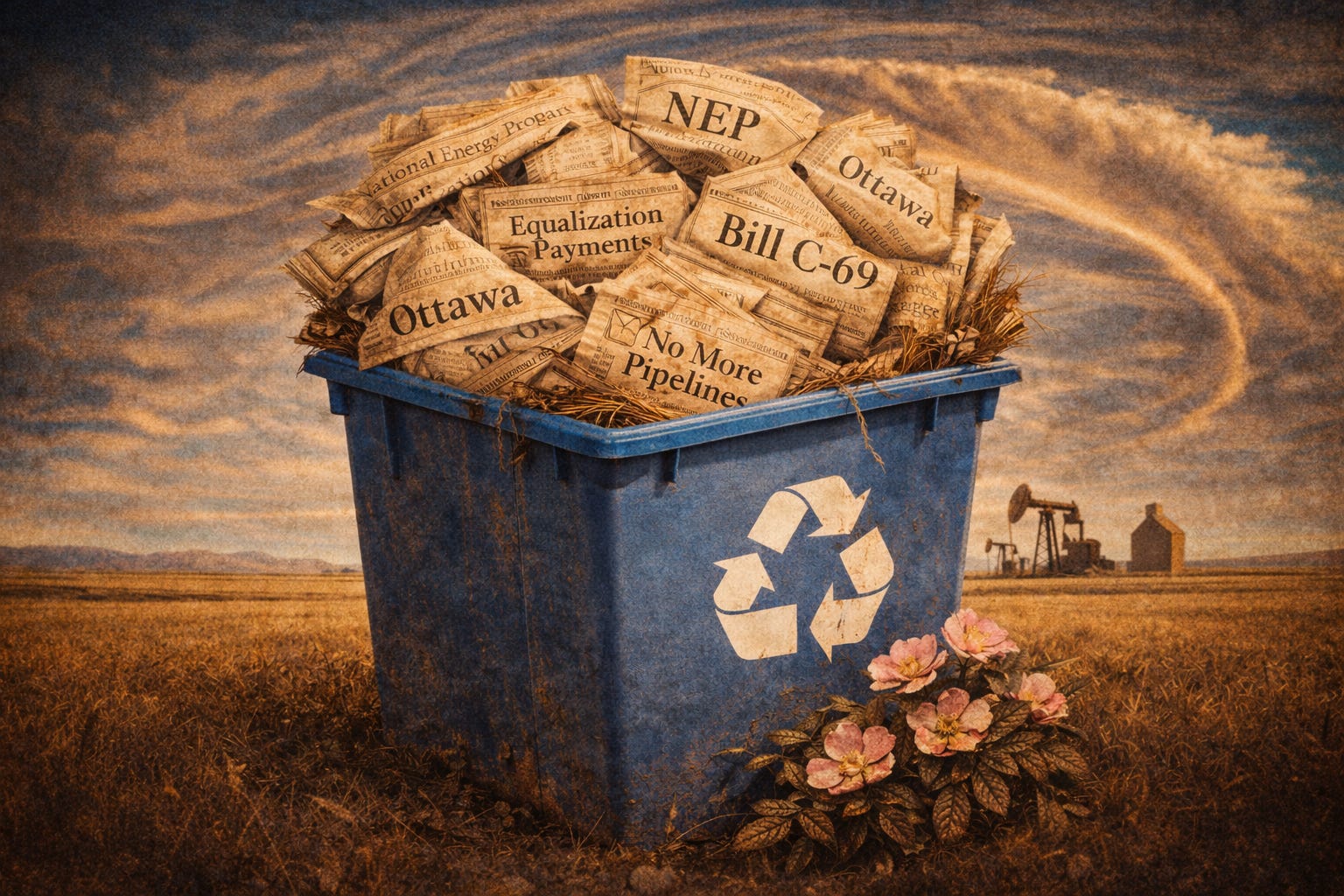
Alberta separatism does not survive on new harms.
It survives by carefully recycling old ones.
The list rarely changes. Ottawa steals Alberta’s wealth. Quebec is favoured. Equalization is unfair. Environmental rules are punitive. Pipelines are blocked because Confederation is broken. Alberta has no voice.
These claims circulate endlessly, not because they are newly true, but because they are useful. Most no longer describe material realities that meaningfully shape life for Albertans today.
They persist because they are doing a different kind of work.
The Story Beneath the Complaints
Canada is not an abstract arrangement dreamed up by policy analysts. It is the product of three foundational peoples and legal traditions: Indigenous nations, the French, and the English. Every province in Canada emerges from this same constitutional inheritance in different combinations.12
Alberta is no exception.
Separatist narratives quietly suggest something else. They imply that Alberta constitutes a distinct political nation within Canada, one that entered Confederation under fundamentally different terms and has been wronged ever since.
That story does not survive contact with history.
Alberta was not a sovereign entity. It did not negotiate entry into Confederation. It did not possess a colonial legislature or an independent constitution. It was created in 1905 by federal statute, carved out of the North-West Territories.3
Its formation took place on land already claimed by the Crown and governed through treaties with Indigenous nations.4
Many grievances depend on the idea of a broken original bargain.
There was no such bargain.
1905 Is Not the Distant Past
Alberta became a province in 1905.
That is less than 130 years ago. For most families in the province, this is not ancient history. It is great-grandparent history. Three generations, maybe four.
The grievances that animate Alberta separatism are not the accumulated injuries of a people over centuries. They are the frustrations of settlers and their descendants navigating boom cycles, rapid growth, and political disappointment inside a very young province.
Confederation did not absorb an ancient polity and strip it of sovereignty. It created a province, governed it imperfectly, and watched it grow wealthy at a pace that would have startled much of the world.
Perspective matters.
South by Northwest: The Quiet Coup from Alberta to Mar-a-Lago

It’s important to get the timeline straight.
The Contrast That Breaks the Spell
This is where comparisons with Quebec quietly fall apart.
Quebec is not simply another province with grievances. It is one of the oldest continuous political and cultural societies in North America. Port Royal was founded in 1605. Quebec City followed in 1608.5
These were not symbolic beginnings. They were lived ones.
French civil law, language rights, religious institutions, and political identity were already firmly established when Confederation arrived. Quebec entered Canada with pre-existing institutions that required accommodation because erasing them would have meant erasing society itself.6
Alberta did not.
This does not make Alberta lesser. It makes the comparison invalid.
Quebec’s claims arise from continuity. Alberta separatist claims arise from dissatisfaction.
Those are not the same thing.
The Missing Layer That Ends the Argument: Treaties
Any discussion of Alberta separatism that does not explicitly address the treaties is constitutionally incomplete.
Almost all of Alberta sits on Treaty land, primarily Treaties 6, 7, and 8. These treaties are not historical artifacts. They are living constitutional agreements that predate the province itself and are recognized under Section 35 of the Constitution Act, 1982.78
Alberta is younger than the treaties that make its existence possible.


This is not what amounts to a moral appeal. It is a legal reality.
Separatist rhetoric often assumes Alberta has a latent sovereignty waiting to be reclaimed through a referendum or declaration. That assumption collapses the moment treaties are acknowledged.
Any serious attempt at secession would necessarily engage treaty relationships and Indigenous constitutional rights. It cannot be treated as a unilateral provincial act.9
Sidebar: Common Law and Droit Civil Are Not Decorative Differences
Canada does not operate under a single legal tradition.
Most provinces, including Alberta, operate under common law, inherited from England. Common law develops through judicial decisions and precedent, evolving case by case over time.
Quebec is different. For private law matters, Quebec operates under droit civil, inherited from France and codified in the Code civil du Québec. This legal tradition was fully established in New France long before Confederation and survived conquest, political transition, and constitutional negotiation.
Droit civil was explicitly preserved through the Quebec Act of 1774 and later entrenched within Canada’s constitutional framework, particularly through the division of powers over property and civil rights.10
Alberta entered Confederation with no distinct legal system requiring preservation or accommodation. Common law was already the governing framework of the North West Territories from which the province was created.
Quebec’s distinctiveness arises from legal and social continuity. Alberta’s governance arises from statutory incorporation.
The Grievances, Briefly and Plainly
Equalization is funded from federal general revenues. Provinces do not send cheques to one another.11
The National Energy Program ended in 1985. Alberta has controlled its natural resources since 1930.12
The federal consumer carbon tax no longer applies. What remains is industrial carbon pricing, much of which in Alberta operates through provincial systems.13
Oil production in Alberta is near record levels. Pipeline constraints arise from court decisions, Indigenous consultation requirements, market risk, and interprovincial conflict. The federal government has approved and purchased major pipeline infrastructure.14
Alberta is not formally disenfranchised. Its frustration is about leverage and outcomes, not exclusion.
If Any Province Had a Claim, It Would Be Newfoundland
If arguments about disrupted sovereignty were taken seriously, the strongest case would not come from Alberta.
It would come from Newfoundland and Labrador.
Newfoundland was a self-governing British Dominion with its own parliament, currency, and legal system. It entered Confederation in 1949 following referendums, not administrative creation.15
Alberta does not meet those criteria.
Loving Canada Means Understanding How Our Democracy Actually Works

There is a strange reflex in Canadian politics right now. It shows up whenever something unfamiliar or a little untidy happens inside our parliamentary system. Someone almost always rushes in to declare it undemocratic. Some of that comes from a genuine rise in political interest, which is not a bad thing. But that interest is often shaped through parti…
The Bottom Line
Alberta is not a fourth founding people. It is not an ancient polity absorbed against its will. It is a young province created by statute in 1905 on Treaty land within an existing constitutional order.
Acknowledging that history does not diminish Alberta.
It clarifies the foundations on which it stands.
What remains is not oppression.
It is politics.
Fault Lines, Part 2 of 3: Who Would Alberta Separation Actually Serve?

If Part 1 was about the story separatism tells, Part 2 is about the part it avoids.
Sources
Constitution Act, 1867. Government of Canada.
https://laws-lois.justice.gc.ca/eng/const/page-1.html
Ajzenstat, J. (2007). The Canadian Founding. Stoddart.
Government of Canada. (1905). Alberta Act.
https://laws-lois.justice.gc.ca/eng/acts/a-2.7/
Indigenous and Northern Affairs Canada. Treaties in Alberta.
https://www.rcaanc-cirnac.gc.ca/eng/1100100028574
Parks Canada. Port Royal National Historic Site.
https://parks.canada.ca/lhn-nhs/ns/portroyal
Quebec Act, 1774.
https://www.thecanadianencyclopedia.ca/en/article/quebec-act
Constitution Act, 1982, s.35.
https://laws-lois.justice.gc.ca/eng/const/page-15.html
Supreme Court of Canada. R v Sparrow (1990).
https://scc-csc.lexum.com/scc-csc/scc-csc/en/item/609/index.do
Supreme Court of Canada. Reference re Secession of Quebec (1998).
https://scc-csc.lexum.com/scc-csc/scc-csc/en/item/1643/index.do
Civil Code of Québec.
https://www.legisquebec.gouv.qc.ca/en/document/cs/ccq-1991
Government of Canada. Equalization Program.
https://www.canada.ca/en/department-finance/programs/federal-transfers/equalization.html
Natural Resources Canada. Resource Ownership.
https://natural-resources.canada.ca
Government of Canada. Carbon Pricing Update.
https://www.canada.ca/en/environment-climate-change/services/climate-change/pricing-pollution-how-it-will-work.html
Canada Energy Regulator.
https://www.cer-rec.gc.ca
Government of Newfoundland and Labrador. Confederation History.
https://www.gov.nl.ca/hcs/confederation/