


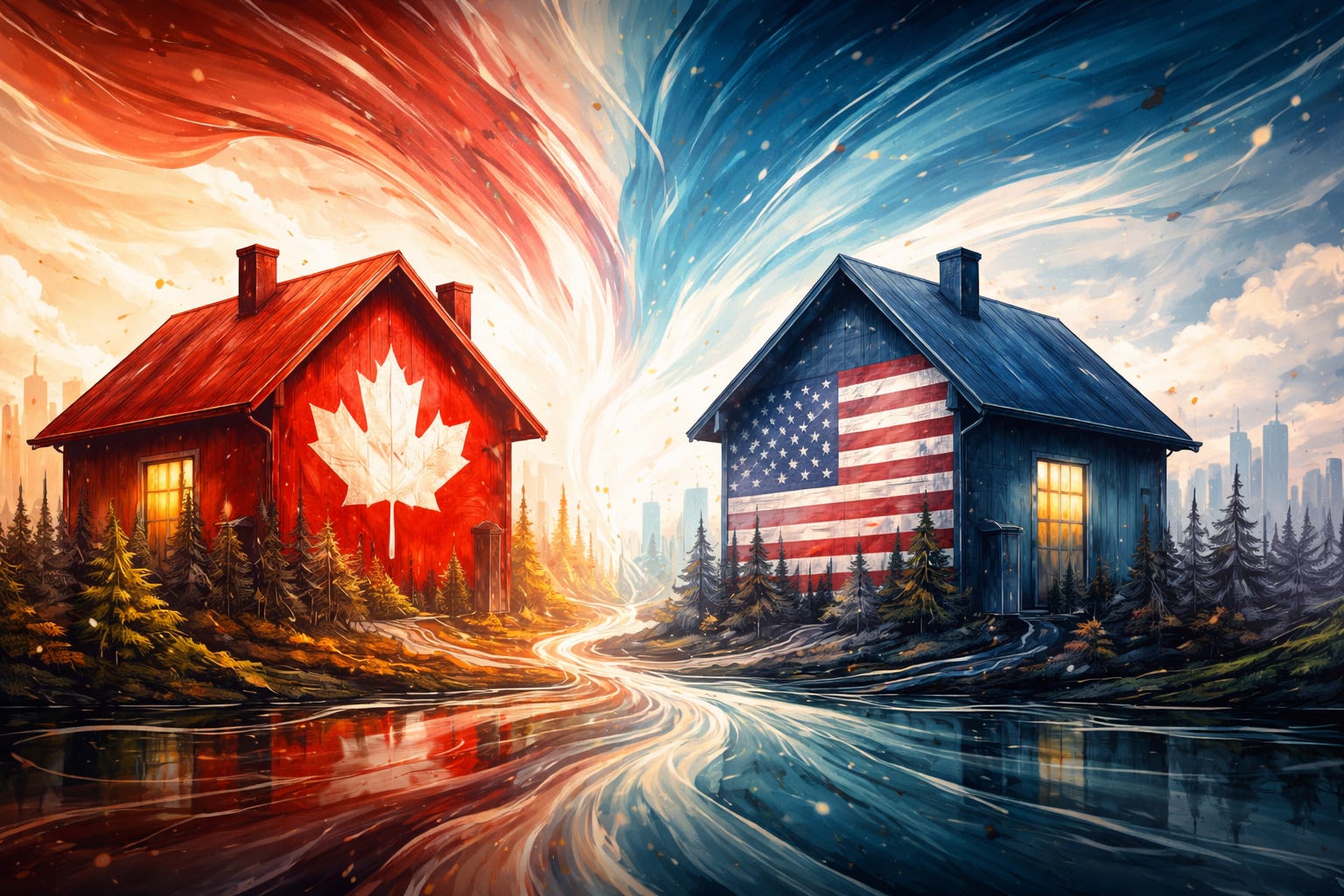
Canada has spent more than a century slowly growing into its independence. From Vimy Ridge to the repatriation of the Constitution, each generation has taken another step toward full sovereignty. The uncomfortable truth today is that one step may still remain: learning how to live next door to the United States without relying on it.
Nobody else grew up quite the way Canadians did.
For most of the twentieth century, the same television signals that reached American living rooms crossed the border and landed in Canadian ones. Broadcast waves rolled north across the 49th parallel with no passports and no customs officers.
We watched the moon landing together.
We heard the same music.
When American networks interrupted programming for major world events, Canadians were often watching the exact same feed.
Today our media worlds are far more global. But for most of the twentieth century Canadians and Americans quite literally watched the same screens.
Geography made us neighbours. Technology made us roommates.
The world called him Uncle Sam.
We just called him Sam.
He was family.
Growing Up Is What You Do
Canada has had several moments when it had to grow up as a country. Not the easy kind of growing up. The hard kind. The kind that leaves marks.
The process did not happen all at once. It happened step by step.
We went into the First World War as a British dominion.
At Vimy Ridge in 1917, Canadian forces fought together under unified Canadian command for the first time. Canadian officers making Canadian decisions. Canadian soldiers paying the cost.
The men who fell there fell as Canadians.
That mattered.
Two years later, in 1919, Canada signed the Treaty of Versailles in its own name and joined the League of Nations as a separate country. For the first time, Canada stood on the world stage not simply as part of the British Empire, but as a nation with its own voice.
The legal independence followed.
In 1931, the Statute of Westminster gave Canada full legislative autonomy. British law no longer automatically applied in Ottawa. Canada could write its own laws.
Then came the Second World War.
This time Canada entered the war as an independent country. When Canadian troops landed at Juno Beach in 1944, they did so not as a colonial attachment but as a national force.
The blood on that beach was Canadian.
The legal ties continued to loosen afterward.
In 1949, Canada ended appeals to the Judicial Committee of the Privy Council in London. From that moment on, the Supreme Court of Canada became the final authority in Canadian law.
After that, Canada increasingly began acting like the independent country it had become.
In 1956, Lester B. Pearson helped defuse the Suez Crisis by proposing the world’s first United Nations peacekeeping force. The diplomatic innovation earned Canada a Nobel Peace Prize and helped establish the country’s reputation as a stabilizing middle power.

The symbols of nationhood followed. In 1965 the Maple Leaf flag replaced the old Red Ensign, giving Canada a national emblem that belonged entirely to itself.
Then, in 1982, the final legal step arrived.
The Constitution came home.
No more flights to London to amend our founding document. Canada gained full control over its own constitutional framework.
Canada slowly pulled the levers of sovereignty back into its own hands.
But piece by piece.
Independence, in Canada, has never arrived all at once.
The Brother in the Room
Growing up next to a very large brother has advantages.
When he is big enough, nobody bothers you.
But it also means you never fully develop your own street smarts.
You do not build your own defence capacity.
You do not build full economic independence.
You do not build strategic autonomy.
Because he is right there.
And his shadow covers you too.
Many countries never had that luxury.
Norway did not.
Finland did not.
The Baltic states certainly did not.
Their geopolitical neighbourhood forced them to grow up quickly.
Norway’s sovereign wealth fund did not emerge from ambition alone. It came from necessity.
In a dangerous neighbourhood you cannot afford dependency. You cannot afford to sell your assets cheaply. You cannot afford to let someone else’s priorities determine your future.
I Loaded Canadian Parliament Into an AI. Here's What I Found.

I was 21 years old when I dropped out of the music program at Western and stumbled into technology.
So Norway invested in itself.
They diversified.
They built resilience.
They grew up.
Canada had Sam.
And Sam was large enough that the neighbourhood did not scare us in the same way.
So we borrowed his street smarts.
Over time we began confusing his priorities with our priorities.
The issue was never that Canada lacked the capability.
The issue was that we rarely had to use it.
The historical record makes that clear.
Consider the Avro Arrow
In the late 1950s Canada had developed one of the most advanced interceptor aircraft in the world. Built in Canada. Designed in Canada. Decades ahead of its time.
The program was cancelled in 1959.
The engineers did not disappear. They went south. NASA. Boeing. The American aerospace sector absorbed the talent.
Canada did not just lose an aircraft program.
It lost an entire aerospace generation.
Another example came in the late 1980s.
Canada once considered creating a strategic petroleum reserve in partnership with the United States. A hedge against supply disruption.
When Washington lost interest, Ottawa quietly lost interest too.
The project faded away.
The pattern is familiar.
Sometimes Sam sidelines the idea.
Sometimes Sam simply is not interested.
Either way we tend to follow his lead.
When you spend your whole life in the same house you begin to assume his map is your map.
Other countries built their own maps because they had to.
Canada often borrowed one.
We are not naive.
Countries change. People change.
Sometimes the brother who always seemed steady begins behaving in ways that do not quite add up.
At first you ignore it.
You make excuses.
You adjust.
But eventually there are signs you cannot ignore.
It starts small.
The tone changes. Conversations that used to be predictable suddenly feel unstable. Things that were once settled are suddenly back on the table.
Trade agreements become bargaining chips.
Allies become adversaries overnight.
The rules that governed the relationship for decades begin to look… negotiable.
Then the requests start.
Tariffs appear where there were none before. Longstanding trade partnerships are suddenly framed as exploitation. Deals that once benefited both sides are recast as if one party has been cheated all along.
And then the rhetoric shifts.
The talk about Canada becoming the fifty first state is not really about annexation. It is something stranger than that. It is the language of someone testing boundaries, saying out loud what used to be unthinkable, just to see how the room reacts.
That is the moment when you realize something deeper is going on.
The tariffs are not really trade policy.
They are pressure.
The fifty first state talk is not policy either.
It is the kind of comment people make when they are no longer certain where the boundaries actually are.
Opinion: Geography Is Not Destiny — But It Can Be Used That Way
There is a recurring argument in Canadian political discourse that deserves careful handling, not because it is wrong, but because of what happens after it is accepted.
And once you see that, every conversation feels a little different.
None of this requires hatred.
We do not hate Sam.
We never have.
Our cultures remain intertwined. Our economies remain linked. Our histories are entangled in ways that cannot be untangled.
He is still family.
But loving someone does not mean handing them the keys to your car.
It does not mean letting their instability become your problem.
And it does not mean postponing your own life indefinitely.
Sam has his issues to sort out.
Canada has its own life to build.
What Maturity Actually Costs
Growing up is expensive.
There is no way around that.
It requires investment.
It requires planning.
It requires accepting that the comfort of the existing arrangement has hidden costs.
Norway’s sovereign wealth fund did not appear by accident.
When oil revenues arrived, Norway made a deliberate decision that those resources belonged to the future as much as the present.
They resisted the easy option of spending everything immediately.
That decision required political will.
It required public trust.
It required independence of thought.
Canada has the assets to make similar choices.
Critical minerals.
Fresh water.
Arable land.
Arctic geography.
Stable democratic institutions.
We are not a small country pretending.
We are a large country that has grown comfortable behaving as though we are smaller than we are.
The question now is whether this moment becomes the crucible that changes that.
Time to Get Our Own Place
This is not an anti American argument.
It never was.
Canada and the United States will remain neighbours, trading partners, and cultural relatives.
None of that changes.
But there is a difference between two independent adults choosing a relationship and one quietly depending on the other.
Canada has lived uncomfortably close to the second arrangement for a long time.
Norway’s path worked not because Norway was lucky but because Norway was deliberate.
The Broke Mind Virus at the Border

For years now, Elon Musk has warned us about the “woke mind virus”—his term for what he sees as an excess of empathy metastasizing into cultural toxicity. But while we’ve been debating the dangers of caring too much, a far more virulent strain has been spreading through the American body politic:
They decided their resources and their sovereignty were worth protecting.
They invested accordingly.
Canada has the intelligence, reputation, and assets to do the same.
What we lacked until now may have been necessity.
Sam is providing it.
The final stage of growing up is always the hardest.
It is the moment when you stop waiting for permission.
Canada has done this before.
At Vimy Ridge.
At Juno Beach.
In 1982 when we finally brought our Constitution home.
Now another step may be in front of us.
The television signals will still cross the border.
We will still hear the same music.
We will still watch the same news.
Sam will still be next door.
But growing up sometimes means moving into your own place.
Not out of anger.
Out of necessity.
And in the quiet confidence of a country that finally understands how big it really is.
Canada does not need to stop loving Sam.
It just needs to stop living in his house.
Matthew Dufresne writes Northern Variables from London, Ontario. He is the founder of Connexxia Inc. and creator of the parliamentary accountability platform CanadaGPT at canadagpt.ca.