



If Part 1 was about the story Alberta separatism tells, and Part 2 was about who benefits if the breakup fantasy ever became real, Part 3 is about the mechanism.
Because people keep picturing annexation the way it looked in the twentieth century.
Tanks. Troops. Borders redrawn by force.
That mental model is comforting.
It is also obsolete.
Modern conquest—when it happens—rarely begins with soldiers. It begins with stories, procedure, and pressure, arranged carefully enough that no one can quite say when the line was crossed.
By the time uniforms appear, the map has already started to change.
The mistake we keep making about power
Troops are loud.
Troops trigger alliances, sanctions, headlines, and decisions. They force everyone to admit what is happening.
So if you are a major power with patience, you do not start with troops.
You start with something cleaner:
a fault line that already exists
a grievance that can be framed as identity
a process you can point to and say: We didn’t do this. They did.
This is the grey zone.
And the blueprint that taught the world how it works has a name.
Crimea was not tanks-first. It was narrative-first.
In early 2014, unmarked soldiers—the “little green men”—appeared in Crimea. They seized infrastructure, controlled public space, and created confusion while Russia denied involvement. A referendum followed, conducted under armed occupation, outside Ukraine’s constitutional framework, and without credible international observation. Only after the facts on the ground were irreversible did formal annexation occur.1
The critical point is not historical detail.
It is sequence.
The early phase did not look like invasion.
It looked like ambiguity.
It looked like local grievance.
It looked like procedure.
The story—about protecting a local population and respecting “self-determination”—was not an afterthought.
It was the weapon.
Sidebar: the Crimea pattern, simplified
Identify a fault line
Feed it until it becomes identity
Trigger legitimacy through procedure (petitions, votes, “democratic mandates”)
Flood the information environment (confusion beats persuasion)
Keep fingerprints off (proxies, deniable intermediaries, “private actors”)
Step in later as the stabilizer—after the state is already fractured
Democracies are slow to respond to “opinions,” even when someone else is shaping them.
That hesitation is the point.
Greenland is the rehearsal you weren’t supposed to watch
If you want a live, Western-hemisphere example of how influence replaces invasion, look at Greenland — not as history, but as a current case study playing out in the news cycle right now.
Greenland is not peripheral. It is one of NATO’s key Arctic nodes, governed by Denmark — a core alliance member — and one of the few Arctic partners without a standing military of its own, alongside Iceland. That combination makes it strategically vital and politically vulnerable at the same time.
In August 2025, Denmark summoned the senior U.S. diplomat after reporting by Danish broadcaster DR alleged that American political operatives linked to Donald Trump were engaged in influence activities inside Greenland.2 3 4The goal was not overt control, but something quieter: stoking internal dissent, amplifying separatist sentiment, and weakening Greenland’s political and emotional ties to Copenhagen.
The reporting emphasized what made the operation effective: deliberate ambiguity. Close enough to power to matter. Distant enough to preserve deniability. No official declarations. No flags. Just pressure applied through narrative, identity, and grievance.
No tanks.
No troops.
No invasion.
Just penetration of the political environment.
That is the modern model.
And it works precisely because it can always be argued away — as free speech, as private actors, as coincidence, as noise. Until the moment it isn’t and the damage is done.
Alberta is not Crimea—but Alberta has a usable seam
Let’s be explicit.
Alberta is not Crimea.
Canada is not Ukraine.
The parallel is not that Alberta will be annexed by force.
The parallel is that separatism creates a seam that external actors can pull on.
Part 1 established the legal reality separatism avoids: Alberta did not enter Confederation as a sovereign state and cannot unilaterally exit without constitutional negotiation and treaty consent.

Part 2 established the incentive reality separatism prefers not to name: separation would not produce autonomy. It would produce dependency, especially on the United States.

Part 3 is where those realities become operational.
Because Alberta separatism is no longer just rhetoric.
It is the infrastructure of annexation.
The petition machine is live—and it has a countdown clock
Elections Alberta currently lists an active citizen initiative petition titled “A Referendum Relating to Alberta Independence.” Signature collection runs from January 3 to May 2, 2026, with a required threshold of 177,732 signatures—ten percent of votes cast in the 2023 provincial election.5
The petition question is blunt: whether Alberta should cease to be part of Canada to become an independent state.6
This week, organizers have been doing what organizers do when a procedural window opens.
They have been lining people up.
Global News reported large turnout at a Red Deer signing event, with claims of waits lasting up to three hours and restrictions on media access during the event.7
Whether the petition succeeds is almost beside the point.
The act of running it does the work.
It turns national politics inward.
It reframes Canada as provisional.
It weakens negotiating posture by broadcasting instability.
That is how grey-zone pressure functions.
Disinformation here is not incidental. It is functional.
Separatism does not require accurate beliefs.
It requires momentum.
And momentum is easiest to manufacture when people misunderstand process.
In 2025, AFP fact-checked viral claims that Alberta independence petitions had already met legal thresholds through online signing, noting that online signatures would not count and that the claims misrepresented how the law actually works.8
Those claims were not merely wrong.
They were useful.
They made separation feel inevitable.
They made resistance feel pointless.
They transformed procedure into destiny.
That is textbook destabilization.
The external chorus is getting louder—and more official
Then the signal arrives, not from fringe accounts, but from cabinet-level officials.
On January 23, 2026, U.S. Treasury Secretary Scott Bessent publicly weighed in on Alberta separatism, referencing a possible referendum and suggesting that Alberta should “come down into the U.S.” while repeating simplified grievance claims about Ottawa blocking Alberta’s interests.9
Two things matter here.
First, a senior U.S. official treated the internal borders of a neighbouring country as a casual talking point.
Second, he did it while signatures are actively being collected.
That is not neutral commentary.
That is amplification.
Davos and the politics of humiliation
The same pressure logic appeared days earlier at Davos.
Prime Minister Mark Carney criticized U.S. economic coercion and warned that it was rupturing the global order.10
Donald Trump responded by revoking Canada’s invitation to his proposed “Board of Peace” initiative.11
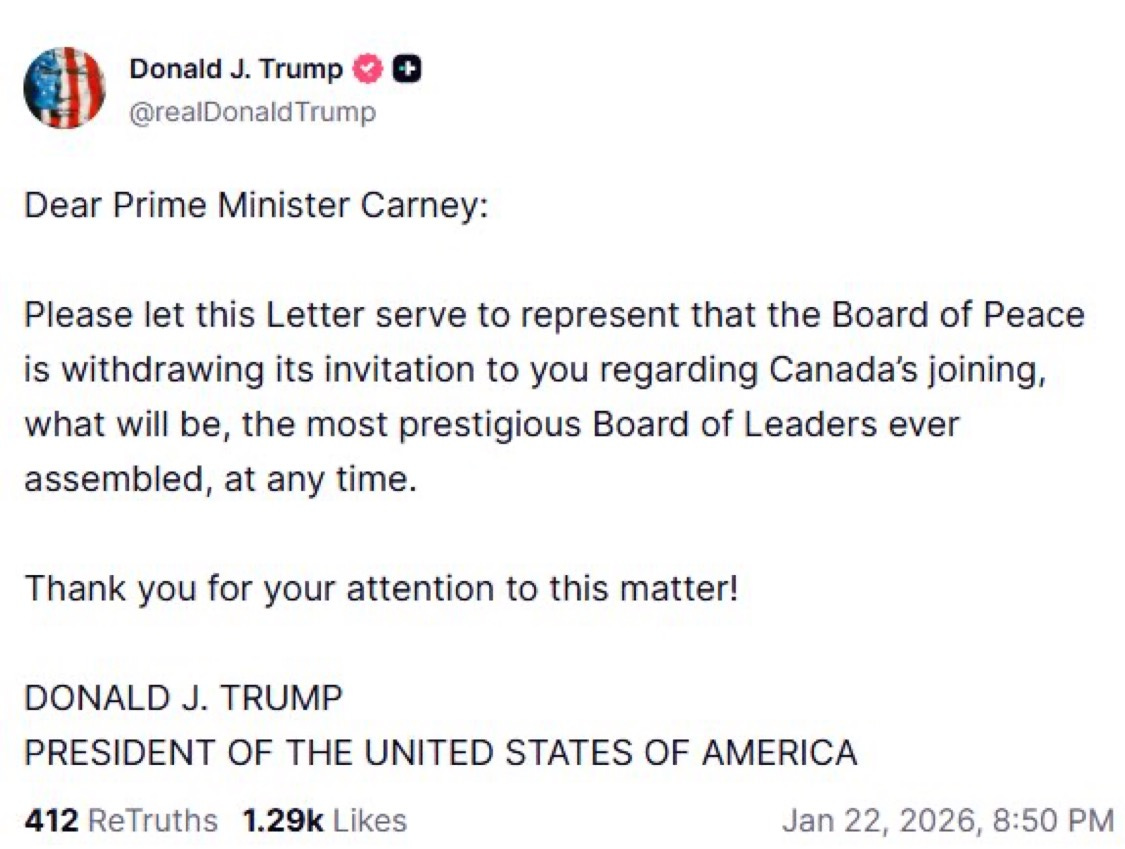
This was not about policy substance.
It was about hierarchy.
Status coercion—reward and punishment, access and exclusion—is how pressure is applied when you do not want escalation.
It tells domestic audiences: your leader can be disciplined.
And it tells grievance movements: Ottawa cannot protect you.
That signal feeds separatism perfectly.
This is not hypothetical: influence operations are already targeting Alberta
If this still feels abstract, it should not.
Recorded Future’s Insikt Group has reported that an influence operation cluster known as “CopyCop” is almost certainly attempting to capitalize on pro-independence sentiment in Alberta, identifying new websites explicitly targeting Canadian audiences and seeking to exacerbate polarization.12
You do not need to speculate about motives when exploitation is observable.
Where coincidence ends
At this point, the argument no longer hinges on intent.
It hinges on pattern.
We also know what this pattern produces in people.
Research from EKOS shows that Canadians most exposed to disinformation do not simply believe isolated falsehoods. They adopt a reinforcing worldview: deep distrust of institutions, belief that democracy is rigged, perception that the country itself is illegitimate, and openness to rupture as the only remaining solution.
Disinformation does not persuade issue by issue.
It restructures identity.
That matters here because it matches—precisely—the psychological profile separatist movements depend on. Not policy disagreement. Not constitutional debate. But a felt sense that the state itself is no longer worthy of loyalty.
When you combine that data with what is now visible in real time—procedural triggers, active petitions, foreign amplification, elite narrative laundering—the conclusion stops being speculative.
This is not coincidence.
This is active destabilization, operating exactly the way modern influence campaigns are designed to operate.
And none of it requires a single command centre.
The Quiet Network: Keiretsu Politics, the IDU, and Canada’s 45th Election

On the surface, it still feels like Canada and the United States operate in different political realities. Different systems. Different traditions. Different parties.
As with other contemporary political networks, coordination emerges through aligned incentives, shared narratives, and mutually reinforcing actors—influence without orders, pressure without ownership.
That is the architecture of the grey zone.
The bottom line
At some point, we have to stop pretending this is subtle.
When a live separatist petition is operating on a fixed clock, when foreign officials casually speculate about Canada’s internal borders, when influence operations are documented exploiting the same fault lines, and when grievance politics is being procedurally converted into leverage, this is no longer background noise.
That’s not an elephant in the room. It’s an eagle.
It is visible.
It is powerful.
And it is not here by accident.
Modern annexation does not begin with tanks.
It begins with fault lines—pushed until the crack becomes a border.
Alberta is not weak. Alberta is not trapped. Alberta is a powerful province inside a wealthy federation, with real constitutional authority and real leverage.
Why Trump really wants Canada (Hint: It's Not the Oil)

AI is changing everything, faster than anything we have built before. We are watching models blow past human performance in task after task, and the compounding is brutal: once you optimize a model for a job, you can scale it at near-zero marginal cost. That is the corporate dream and the state’s dream: swap the most expensive input, human labor, for in…
That is why this matters.
Because the point of destabilization is not to “free Alberta.”
It is to use Alberta.
The strongest Alberta future is still the one where Alberta refuses to become a seam for someone else’s leverage—and where Canadians stop mistaking grey-zone politics for just another weekend argument.
This is not about patriotism as a slogan.
It is about understanding how power works now.
And refusing to be split along the lines it is actively searching for.
Sources
Organization for Security and Co-operation in Europe. (2014). Report on the human rights situation in Ukraine.
https://www.osce.org/files/f/documents/5/9/448597.pdf
Associated Press. (2025, August 27). Denmark summons US envoy over claims of interference in Greenland.
https://apnews.com/article/6c9544314792cf1e287e21af06111c1e
Time. (2025, August 27). Denmark summons U.S. envoy over Trump-linked covert influence operation in Greenland.
https://time.com/7312624/greenland-covert-operation-trump-denmark/
PBS NewsHour. (2025). Denmark summons U.S. envoy over claims of interference in Greenland.
https://www.pbs.org/newshour/world/denmark-summons-u-s-envoy-over-claims-of-interference-in-greenland
Elections Alberta. (2026). New citizen initiative petition issued – “A Referendum Relating to Alberta Independence.”
https://www.elections.ab.ca/new-citizen-initiative-petition-issued-2/
CityNews. (2026, January 2). Alberta issues petition for proposed independence referendum.
https://calgary.citynews.ca/2026/01/02/alberta-referendum-citizen-initiative/
Global News. (2026). ‘This is overwhelming’: Alberta separatists praise turnout for petition signing.
https://globalnews.ca/news/11615147/alberta-separatists-praise-turnout-petition-signing/
AFP Fact Check. (2025, May 14). Alberta independence referendum petition must register with election agency.
https://factcheck.afp.com/doc.afp.com.46JQ8Z
CityNews Toronto. (2026, January 23). ‘We should let them come down into the U.S.’: Bessent weighs in on Alberta separatism.
https://toronto.citynews.ca/2026/01/23/we-should-let-them-come-down-into-the-u-s-bessent-weighs-in-on-alberta-separatism/
CBS News. (2026). Carney warns of U.S. economic coercion at Davos. https://www.cbsnews.com/news/canada-mark-carney-speech-davos-trump-rupturing-world-order/
Associated Press. (2026). Trump revokes Canada’s invitation to “Board of Peace.” https://apnews.com/article/39dafe866bab610a18f103622fc7d5fe
Recorded Future, Insikt Group. (2025). CopyCop deepens its playbook with new websites and targets. https://www.recordedfuture.com/research/copycop-deepens-its-playbook-with-new-websites-and-targets